

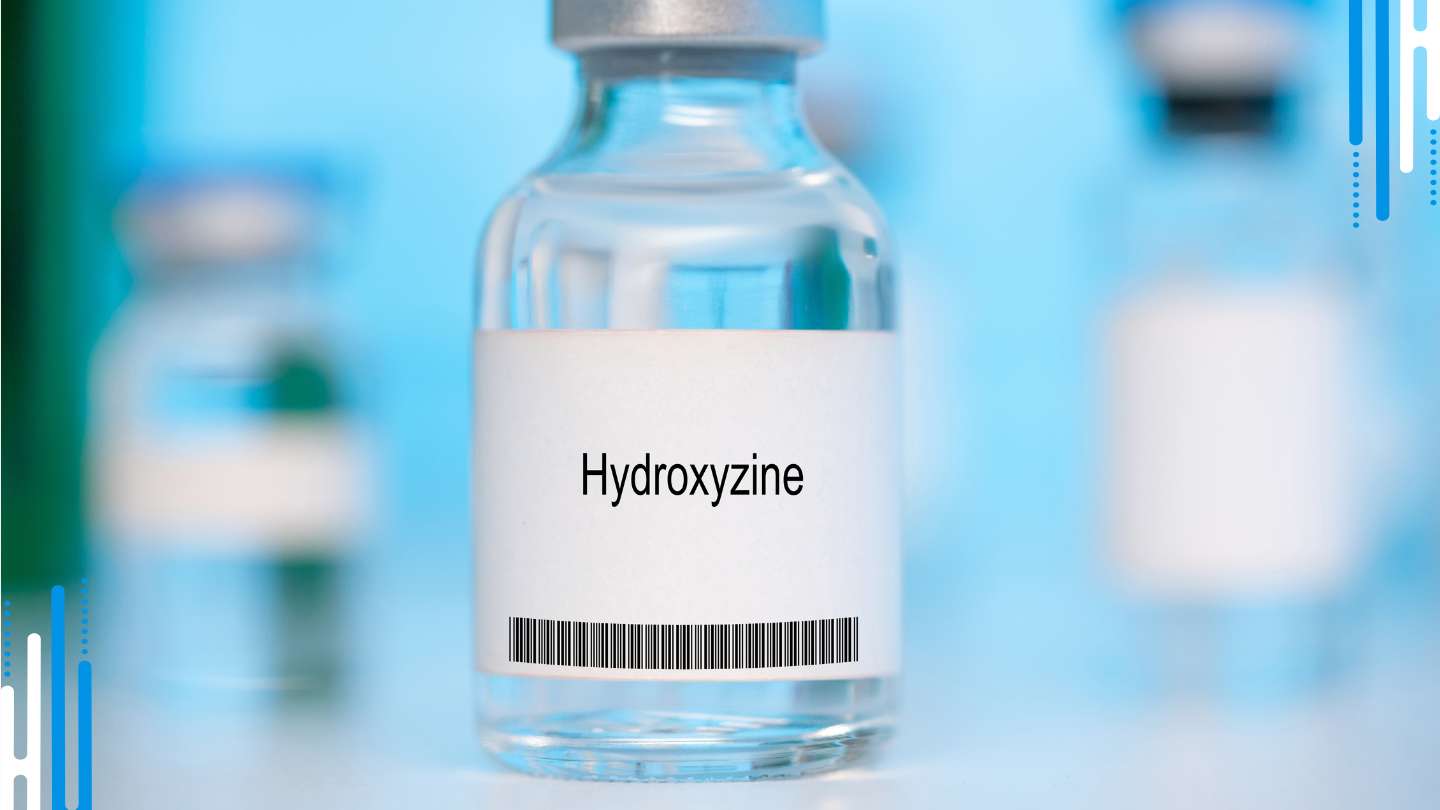
Hydroxyzine is a prescription antihistamine that makes most people sleepy. Because it calms without being a benzodiazepine, it is often offered during benzodiazepine withdrawal and sometimes described online, alongside chamomile tea, as a natural aid. It is made in a factory, not grown in a garden.
So, what can it actually do for a person tapering off of Xanax (alprazolam), Klonopin (clonazepam), Ativan (lorazepam), or Valium (diazepam)? It may take the edge off of a bad night or an anxious afternoon. It cannot do the work of the taper itself, and it cannot make the taper unnecessary.
Hydroxyzine, sold as a generic and under the brand name Vistaril, belongs to the first generation of antihistamines, the older, drowsy kind, and it needs a prescription. Its United States Food and Drug Administration (FDA) label describes it as “not a cortical depressant,” with its calming effect coming from deeper regions of the brain.
A benzodiazepine works differently. It boosts gamma-aminobutyric acid (GABA), the brain’s main calming chemical, at a specific site on the GABA-A receptor, and the Ashton Manual, written by Professor C. Heather Ashton, explains in Chapter 1 that every benzodiazepine acts as a booster at that receptor.
Hydroxyzine does not touch that site. It blocks histamine receptors, and its sleepiness is a side effect put to use on purpose. In fact, the two drugs share a symptom list, drowsiness and calm, and almost nothing else.
Physical dependence on a benzodiazepine is a receptor story. With regular use the brain turns down its own calming response to make room for the drug, and when the dose drops, the brain is left with less calming than it needs. Withdrawal symptoms are that shortfall showing.
Only two things close the gap: time, and a dose that comes down slowly enough for the brain to readjust at each step. The FDA’s 2020 boxed-warning update for the benzodiazepine class says the same: stopping abruptly or cutting the dose too quickly can set off withdrawal reactions that may be life-threatening, and the way off is a gradual taper.
Hydroxyzine adds nothing to that receptor and takes nothing away from it. So, a person who feels better on hydroxyzine has not become less dependent, and a person who stops hydroxyzine has lost no taper progress.
Because withdrawal has bad nights and bad afternoons, and a sedating antihistamine can sometimes soften one. Relief of anxiety and tension is among the label’s approved uses, while use during benzodiazepine withdrawal is off-label and aimed at symptoms only. The evidence for it is thin, and what follows is clinical practice, which varies from one doctor to the next.
While this is not a perfect analogy, think of the nervous system during a taper as a house whose thermostat is turned down one notch at a time. The taper is the thermostat. Hydroxyzine is a blanket.
A blanket can make a cool evening more bearable. Yet, it does not change the thermostat, and the house still has to get used to each new setting. A blanket is never a reason to turn the thermostat down faster.
The label also says that hydroxyzine’s usefulness for anxiety beyond four months has not been assessed. That makes it a short-term tool for a spike, a rough week after a reduction, not a companion for a taper that lasts a year.
The hydroxyzine label, the drug’s own prescribing information, lists drowsiness first, calls it usually temporary, and cautions against driving or operating machinery. Dry mouth is next, and patients often describe dizziness and a heavy, groggy morning after an evening dose.
The heart warning is the one most often left out. The label reports cases of QT prolongation, a lengthening of the heart’s electrical reset time on a heart tracing, and torsade de pointes, a dangerous rhythm that can follow it. Anyone with a heart-rhythm problem, or on other medications that lengthen the QT interval, needs that conversation with a prescriber first.
The label also warns that hydroxyzine adds to the effect of other drugs that depress the central nervous system, and a benzodiazepine or a z-drug such as Ambien, or zolpidem, is exactly that kind of drug. Together they mean more sedation and slower reactions.
Finally, the label notes rare reports of tremor and convulsions, usually at doses well above the recommended range. Seizures are also a known risk of abrupt benzodiazepine withdrawal, and Chapter 3 of the Ashton Manual calls them extremely rare with slow tapering. Call emergency services for a seizure or any medical emergency.
Xanax, or alprazolam, is short-acting, and that changes the picture. Table 1 of the Ashton Manual lists its half-life at six to twelve hours, against twenty to one hundred hours for Valium, or diazepam, and Chapter 1 describes patients on short-acting benzodiazepines developing anxiety between doses. That between-dose anxiety is known as interdose withdrawal.
Hydroxyzine can blunt an anxious evening. It cannot smooth out a blood level that rises and falls several times a day, because it does nothing at the receptor where the fall is felt. Patients who try it for interdose withdrawal often describe the hours before the next Xanax dose as just as hard, only sleepier.
The Manual’s answer, in Chapter 2, is to substitute diazepam, the crossover taper: a gradual switch from the short-acting drug to one whose slow elimination lets the blood level fall smoothly. Dr. Mark Leeds uses that crossover where it helps, and the reasoning is on his Ashton Manual method page. It is the crossover, not the antihistamine, that fixes interdose withdrawal.
Withdrawal is often described as a few-week acute phase followed by a protracted phase, as if it ran on a calendar. That calendar belongs to abrupt withdrawal, never the model here. During a slow taper, symptoms wax and wane, in the words of the Manual’s Chapter 3, varying from day to day, with windows of feeling normal that grow longer as the taper goes on.
The shape of a good taper is a small step, a hold until the person feels steady, then another small step. Professor Ashton suggests reductions of up to one tenth of the dose at each step and is firm that the patient must be in control of the pace. The Maudsley Deprescribing Guidelines refine that shape into a hyperbolic taper, where each reduction gets smaller as the dose falls, because the last milligrams do the most work at the receptor.
That is why no milligram schedule appears here. The number belongs to the patient and the prescriber, revised as the body reports back, and the Manual notes that many people have taken a year or more.
Fortunately, the Manual is just as clear about the other direction: withdrawal symptoms can be minimized and largely avoided by slow tapering suited to the person. Lingering symptoms, known as protracted withdrawal, do fade, even though nobody can promise a date.
Unfortunately, hydroxyzine is often handed out in the wrong setting. Some short-stay facilities stop the benzodiazepine within days and cover the aftermath with a “comfort medication,” and hydroxyzine is a favorite because it is cheap and sedating. The person goes home with a bottle of antihistamine and a nervous system that has just been through an abrupt stop.
That practice rests on a mistaken idea about who the patient is. A person who took a benzodiazepine as prescribed and now cannot stop has a medical condition caused by the medication, and physical dependence is not addiction. The treatment that matches the condition is gradual, patient-directed tapering, with the prescribing physician slowing the pace whenever the body objects.
Of course, many of the people in those facilities mean well. Yet, the fix is not a better comfort medication, and no adjunct on any pharmacy shelf has ever rescued a taper that was going too fast.
Dr. Leeds is an osteopathic physician and deprescribing specialist in Fort Lauderdale, Florida, and he decides on adjuncts one patient at a time. When a patient asks about hydroxyzine, his first question is whether the taper is going too fast, because a run of sleepless nights after a reduction usually means the last step was too big. The answer is a hold, or a slower pace from there, not a sedative.
When the pace is right and a patient still has a hard stretch, a short course of hydroxyzine may be reasonable, weighed against the heart-rhythm caution and the added sedation, and stopped when the stretch passes. Informed consent comes first: the risks, the alternatives including no added medication at all, a plan for when it stops, and the patient’s right to say no. The patient sets the pace, and the doctor’s job is to say when to slow down.
Dr. Leeds’ practice provides medically supervised benzodiazepine and z-drug tapering for patients in Florida, by telemedicine and at his Fort Lauderdale office, working directly with each patient. Whether hydroxyzine has a small part in a given taper is a question for the visit, not the search bar. Contact Dr. Leeds to ask about a gradual, medically supervised taper.
This article is educational. It is not medical advice, and reading it does not create a doctor-patient relationship. Decisions about starting, continuing, or tapering any medication should be made with your own physician.

Mark Leeds, D.O. is an osteopathic physician and deprescribing specialist in Fort Lauderdale, Florida. He helps patients come off benzodiazepines and sleeping pills with a slow, patient-directed taper guided by the Ashton Manual and the Maudsley Deprescribing Guidelines. Physical dependence is not addiction, and a careful taper is measured in months, not days.
Contact Us for expert guidance on safely tapering off benzodiazepines and reclaiming your life.