

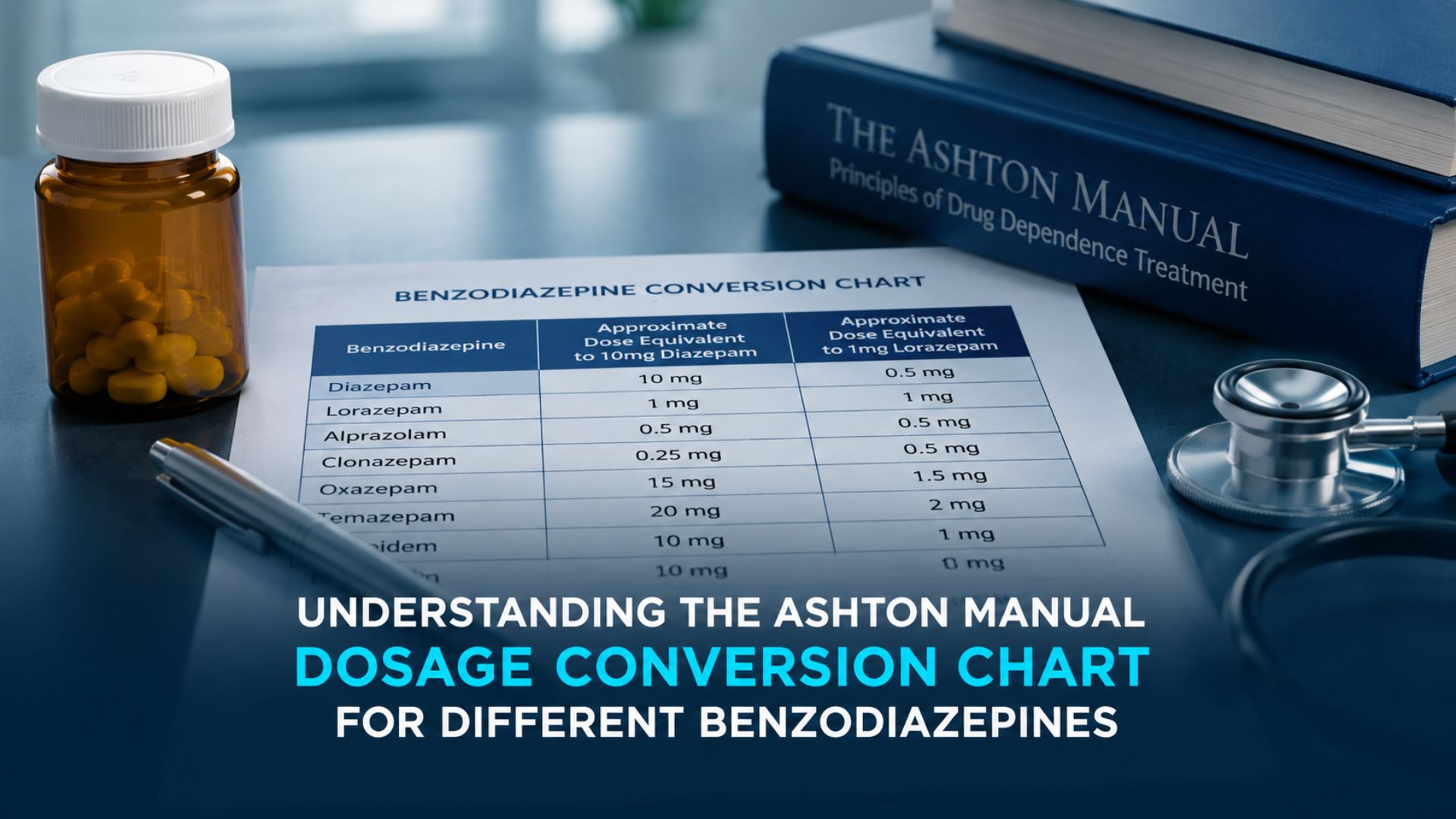
Anyone reducing a long-term benzodiazepine prescription runs into the same question early on. If one medication is stronger than another, how does a physician decide what an equal dose actually looks like? These medicines differ in potency, how long they stay active, and how the body clears them, so milligram for milligram comparisons fall apart quickly. That is the gap the Ashton Manual conversion chart was built to fill. The short version: the chart estimates comparable strengths across benzodiazepines and z-drugs, equivalent does not mean identical, and a conversion is a clinical decision that belongs under physician supervision, never a self-directed calculation. What follows covers what the chart is, how equivalence is estimated, what shapes those estimates in real patients, and why the chart belongs in a physician’s hands rather than a spreadsheet at home.
Two benzodiazepines at the same milligram strength can behave nothing alike. Alprazolam is far more potent per milligram than diazepam, and clonazepam is similar to alprazolam in potency but differs in duration. Layer on half-life, which ranges from a few hours to well over a day depending on the drug and its active byproducts, and the picture gets complicated fast. A person switching medicines without accounting for those differences can end up badly underdosed, which is exactly the situation a careful taper is designed to avoid.
This is why a physician looks past the number printed on the label. Dr. Mark Leeds reviews which medication a patient takes, at what strength, how often, for how long, and what has happened during past attempts to reduce. Patients in Florida sometimes start by shopping for a facility, and it helps to understand first why a benzo recovery center cannot deliver an Ashton Manual taper, since supervised care in this setting means a physician and months of time, not a program with a discharge date. Only after the full picture is clear does a conversion figure mean anything useful, since the chart supplies an anchor point rather than an answer.
The Ashton Manual came out of years of clinical work by Professor C. Heather Ashton with patients withdrawing from prescribed benzodiazepines. It describes gradual, physician-supervised dose reduction rather than abrupt stopping, and it remains one of the few reference documents written specifically from the perspective of people harmed by these medications. Its equivalence table is the section most patients encounter first, though the reasoning around that table matters more than the numbers themselves.
The manual’s central idea is that reduction should be slow enough for the nervous system to adjust between steps, and flexible enough to pause when symptoms escalate. Patients who want a practical picture of how that plays out often find it helpful to know how the Ashton Manual helps people safely reduce benzodiazepines before their first appointment. Coming in with that context tends to make the conversation about a taper schedule far more productive.
An equivalent dose is the approximate amount of one benzodiazepine expected to produce a similar effect to a given amount of another. The Ashton chart expresses these as diazepam equivalents, which is why diazepam is often the reference point in discussions about crossover. If a patient takes a short-acting medication with a sharp peak and a fast drop-off, converting some or all of it into a longer-acting equivalent can smooth out the swings between doses that make reduction so difficult.
The word approximate is doing real work in that sentence. The Manual’s own note under its equivalence table says the figures are firmly based on clinical experience but may vary between individuals, and that they do not agree with those used by some other authors. Two patients on the same dose of the same medication for the same length of time can respond very differently to an identical conversion. That variability is expected, not a sign that something has gone wrong, and it is one of the main reasons conversions are made incrementally rather than in a single step.
Duration of action shapes how a conversion feels day to day. A medication cleared quickly can produce interdose symptoms before the next dose is due, which some patients experience as anxiety, restlessness, or a return of the very symptoms the drug was prescribed for. A longer-acting equivalent holds a steadier level in the bloodstream, which is why the manual leans toward diazepam as a crossover target. The tradeoff is that longer-acting medications take more time to reach a stable level, so the effect of any change is slower to read.
Charts describe averages. Patients are not averages. How long someone has taken a benzodiazepine is one of the strongest influences on how a conversion is handled, since years of use generally call for a more cautious approach than months. Liver function affects clearance, and age changes distribution and elimination in ways that can make a standard figure too aggressive. Previous reduction attempts matter a great deal too, particularly if a rapid taper in the past left lasting sensitivity.
Symptom pattern is another input. Some patients experience clear windows and waves, stretches of relative ease broken by harder periods, and the timing of those cycles influences when a change is made. Others experience tolerance withdrawal, where symptoms appear while the dose is unchanged. Gathering this history is a large part of starting an Ashton Manual taper safely, because the same starting dose can lead to two very different plans depending on what the patient reports.
This distinction gets lost constantly, and it matters enormously to the people living it. A patient who took a benzodiazepine exactly as prescribed and now cannot stop has a physical dependence caused by the medication itself. That is a medical condition, not an addiction. There is no escalating pursuit of the drug and no compulsive use. The nervous system has simply adapted to the medication’s presence, and it needs time to adapt back.
The difference is not academic. Addiction framing pushes people toward rapid withdrawal models built for a different problem entirely, and those models are the single most common source of serious harm in this population. Dr. Leeds’ practice treats benzodiazepine dependence as what it is, a medication injury requiring a slow and carefully monitored reduction. Understanding this reframing is often what makes the conversion chart make sense, because the goal is stability rather than speed.
A conversion is one decision inside a much longer process. Before any change is made, the current dose needs to be stable, since converting an already unstable pattern only adds a variable. Once stability is established, a crossover is usually done in stages, replacing a portion of the short-acting medication with its longer-acting equivalent and holding at each stage long enough to see how the patient responds before continuing.
After the crossover completes, reduction typically follows a hyperbolic pattern, meaning each cut removes a percentage of the current dose rather than a fixed milligram amount. Cuts get smaller in absolute terms as the dose falls. Patients following this approach often benefit from knowing how a benzo tapering schedule based on the Ashton Manual is paced, since the pacing over months and sometimes years is what most people underestimate.
The chart is publicly available, which leads some patients to attempt a conversion on their own. The risk is not that the arithmetic is difficult. It is that the arithmetic is the least important part. A conversion done without clinical oversight can produce a sudden effective drop in dose, and abrupt reductions in this class of medication can bring on severe and sometimes prolonged symptoms, including kindling, where each poorly managed attempt makes the next one harder. A seizure, or any other medical emergency, is a reason to call 911 at once.
Supervision also means someone is watching the response and adjusting. Compounded liquid preparations allow for fine dose control at low doses where standard tablets cannot be split accurately, and knowing when that becomes necessary requires clinical judgment. Dr. Leeds works directly with each patient in Florida, monitoring symptoms and adjusting the pace as the taper proceeds, so the plan reflects the person rather than a chart.
The Ashton Manual conversion chart is a useful reference and a poor instruction manual. It gives physicians a defensible starting point for comparing medications that differ in potency and duration, and it gives patients a way to understand why a doctor might suggest switching to a longer-acting medication before beginning a reduction. What it cannot do is account for the medical history, symptom pattern, and individual sensitivity that determine how a taper should be paced. Those things come from an actual clinical relationship, sustained over the length of the taper.
BenzoDoc is the website of the medical practice of Dr. Leeds, an osteopathic physician and deprescribing specialist in Fort Lauderdale who provides medically supervised tapering for patients in Florida who are reducing benzodiazepines or z-drugs. Care is grounded in the Ashton Manual method for benzodiazepine tapering and adapted to each person’s response over time. Patients can learn more through benzodiazepine information, background on what benzodiazepines are, an overview of risks and side effects, and guidance on safe tapering and discontinuation. Contact Dr. Leeds to discuss a taper plan built around your situation.
This article is educational. It is not medical advice, and reading it does not create a doctor-patient relationship. Decisions about starting, continuing, or tapering any medication should be made with your own physician.

Mark Leeds, D.O. is an osteopathic physician and deprescribing specialist in Fort Lauderdale, Florida. He helps patients come off benzodiazepines and sleeping pills with a slow, patient-directed taper guided by the Ashton Manual and the Maudsley Deprescribing Guidelines. Physical dependence is not addiction, and a careful taper is measured in months, not days.
Contact Us for expert guidance on safely tapering off benzodiazepines and reclaiming your life.